

The Black Death of the 14th century that devastated Europe didn’t leave South Tyrol unscathed. Thought to have arrived in Europe in 1346, probably via the Genoese trading port of Kaffa (modern Feodosia in Crimea), the plague quickly spread across the land and left no city, town or village unscathed. The disease struck every level of society; while the upper classes might have been able to escape by retreating to rural estates, ordinary townspeople and peasants had far fewer opportunities to avoid infection.
Quiet roads through the mountains
Bolzano, today the capital of South Tyrol, was established as a market town in the late 1100s along the trade route between Venice and Verona to the south of the Alps, and Munich and Augsburg to the north. Built up around the Laubengasse (Via dei Portici) and the surrounding markets, the town quickly became economically powerful and a vital stopover on any merchant’s journey across the mountains. The town and its residents relied on income from merchants and travellers but, during the dark years of the plague, travel all but dried up.
It took 200 years for the amount of goods passing over the Brenner Pass, today’s border between Austria and Italy and for centuries one of the easiest places to cross the mountains, to reach the levels of the year 1300. Historians estimate that trade across the Brenner did not recover to its pre-plague levels until the beginning of the 16th century, which shows the stark consequences of the plague, not only during the pandemic itself but for the years and decades after.
The post-plague years were a period of reforestation in Europe: the death toll was so great that, with no one left to tend them, fields were reclaimed by nature. No specific information from Tyrol survives, but we can imagine that the Adige valley that stretches south from Bolzano would look very different than it does today with its endless orchards and vineyards.

© Bolzano Walking Tours
A punishment from God?
Throughout Europe, the Black Death was seen by many as divine punishment for humanity’s sins. Society in the 1300s was religious in a way we can scarcely imagine today; religion shaped almost every aspect of daily life, and few people questioned the authority of the Church or the existence of God. But why might God be angry and want to punish society? Different places came up with their own theories, and Tyrol was no different.
At the time, Margarethe von Tyrol-Görz was the Countess of Tyrol, a larger region than today’s South Tyrol which encompassed Austrian Tyrol, as well as other areas of Southern Austria and Northern Italy. In 1330 she had married Johann Heinrich von Luxemburg to secure an alliance between the houses of Tyrol-Görz and Luxemburg. After an unhappy few years of marriage and pressure from other nobles who didn’t want the Luxemburgs to have power in the region, Johann Heinrich was forced out of the land.
Louis IV of Bavaria, Holy Roman Emperor, was following the developments with interest and soon offered his own son, another Louis, to replace Johann Heinrich as Margarethe’s husband. No expense was spared at the wedding, and Margarethe and Louis were married in 1342. The first marriage had never been declared invalid by the Church and the new marriage was deeply controversial.
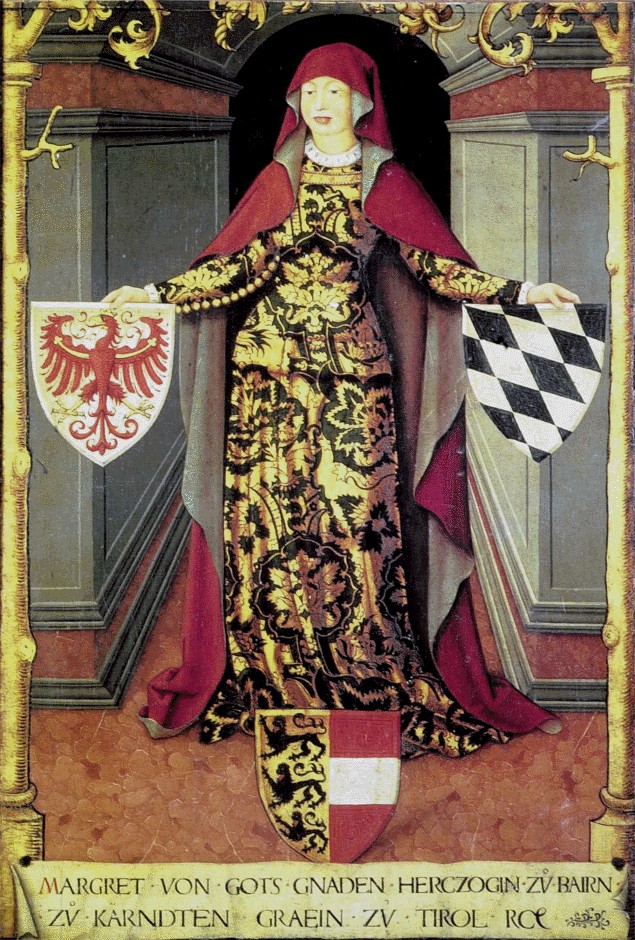
Margarethe and Ludwig were excommunicated by Pope Clement VI and for a time Tyrol was placed under an interdict, severely restricting public religious services. Many in Tyrol saw the outbreak of the plague a few years later as a confirmation of the couple’s wrongdoing and punishment for their behaviour. Until the marriage was finally annulled 16 years later, no mass could be read and no sacrament could be offered in Tyrol, which further distressed the population at an already extremely distressing time.
Margarethe von Tyrol-Görz would go down in history as Magarethe “Maultasch”, a nickname whose meaning remains disputed amongst historians, but is almost certainly an insult.
Sources
Forcher, M. & Peterlini, H. K. (2010). Südtirol in Geschichte und Gegenwart. Innsbruck: Haymon Verlag
Rauch, G. (2012). Bozner Obstplatz: Historisches und Alltägliches. Bolzano: Athesia
Wikipedia. The Black Death. https://en.wikipedia.org/wiki/Black_Death
Leave a Reply